 |
libpromeki main
PROfessional MEdia toolKIt
|

|
|
libpromeki main
PROfessional MEdia toolKIt
|
|
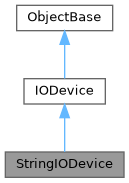
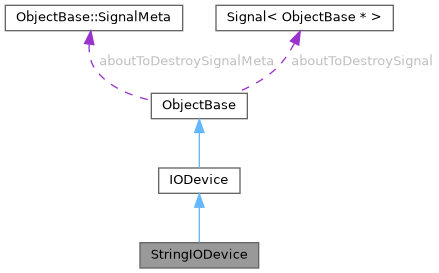
IODevice backed by a promeki String. More...
#include <stringiodevice.h>
Public Member Functions | |
| StringIODevice (String *string, ObjectBase *parent=nullptr) | |
| Constructs a StringIODevice with an external String. | |
| StringIODevice (ObjectBase *parent=nullptr) | |
| Constructs a StringIODevice with no string. | |
| ~StringIODevice () override | |
| Destructor. | |
| void | setString (String *string) |
| Sets the underlying String. | |
| String * | string () const |
| Returns the underlying String, or nullptr. | |
| Error | open (OpenMode mode) override |
| Opens the device with the specified mode. | |
| Error | close () override |
| Closes the device. | |
| bool | isOpen () const override |
| Returns true if the device is open. | |
| int64_t | read (void *data, int64_t maxSize) override |
| Reads up to maxSize bytes into data. | |
| int64_t | write (const void *data, int64_t maxSize) override |
| Writes up to maxSize bytes from data. | |
| int64_t | bytesAvailable () const override |
| Returns the number of bytes available for reading. | |
| bool | isSequential () const override |
| Returns true if the device is sequential (non-seekable). | |
| Error | seek (int64_t pos) override |
| Seeks to the given byte offset from the beginning. | |
| int64_t | pos () const override |
| Returns the current read/write position. | |
| Result< int64_t > | size () const override |
| Returns the total size of the device in bytes. | |
| bool | atEnd () const override |
| Returns true if the current position is at the end. | |
 Public Member Functions inherited from IODevice Public Member Functions inherited from IODevice | |
| IODevice (ObjectBase *parent=nullptr) | |
| Constructs an IODevice. | |
| virtual | ~IODevice () |
| Destructor. | |
| virtual void | flush () |
| Flushes any buffered output data to the underlying device. | |
| virtual bool | waitForReadyRead (unsigned int timeoutMs=0) |
| Waits until data is available for reading or timeout. | |
| virtual bool | waitForBytesWritten (unsigned int timeoutMs=0) |
| Waits until all pending data has been written or timeout. | |
| OpenMode | openMode () const |
| Returns the current open mode. | |
| bool | isReadable () const |
| Returns true if the device is readable. | |
| bool | isWritable () const |
| Returns true if the device is writable. | |
| Error | error () const |
| Returns the current error state. | |
| void | clearError () |
| Clears the error state to Ok. | |
| PROMEKI_SIGNAL (readyRead) | |
| Emitted when data is available for reading. | |
| PROMEKI_SIGNAL (bytesWritten, int64_t) | |
| Emitted when bytes have been written. | |
| PROMEKI_SIGNAL (errorOccurred, Error) | |
| Emitted when an error occurs. | |
| PROMEKI_SIGNAL (aboutToClose) | |
| Emitted just before the device is closed. | |
| Public Member Functions inherited from ObjectBase | |
| ObjectBase (ObjectBase *p=nullptr) | |
| Default ObjectBase constructor. | |
| virtual | ~ObjectBase () |
| Destructor. Emits aboutToDestroy, detaches from parent, and destroys children. | |
| ObjectBase * | parent () const |
| Returns the parent object, if one. nullptr if none. | |
| void | setParent (ObjectBase *p) |
| Sets the parent of this object. If the object already has a parent, it will be removed as a child from the old parent and added as a child to the new one. | |
| const ObjectBaseList & | childList () const |
| Returns a list of children of this object. | |
| template<typename... Args> | |
| int | registerSlot (Slot< Args... > *slot) |
| Registers a slot with this object and assigns it an ID. | |
| EventLoop * | eventLoop () const |
| Returns the EventLoop this object is affiliated with. | |
| void | moveToThread (EventLoop *loop) |
| Changes the EventLoop affinity of this object. | |
| int | startTimer (unsigned int intervalMs, bool singleShot=false) |
| Starts a timer on this object's EventLoop. | |
| void | stopTimer (int timerId) |
| Stops a timer previously started with startTimer(). | |
| template<typename... Args> | |
| PROMEKI_NAMESPACE_BEGIN void | connect (Signal< Args... > *signal, Slot< Args... > *slot) |
Additional Inherited Members | |
| Public Types inherited from IODevice | |
| enum | OpenMode { NotOpen = 0x00 , ReadOnly = 0x01 , WriteOnly = 0x02 , ReadWrite = ReadOnly | WriteOnly , Append = 0x04 | WriteOnly } |
| Mode flags controlling how a device is opened. More... | |
| Public Types inherited from ObjectBase | |
| using | SlotVariantFunc = std::function< void(const VariantList &)> |
| Function type for invoking a slot with a list of Variants. | |
| Static Public Member Functions inherited from ObjectBase | |
| static const MetaInfo & | metaInfo () |
| Returns the MetaInfo for the ObjectBase class. | |
| template<typename... Args> | |
| static void | connect (Signal< Args... > *signal, Slot< Args... > *slot) |
| connects a signal and slot together. This function assumes both the signal and slot exist in a ObjectBase or derived object | |
| Public Attributes inherited from ObjectBase | |
| Signal< ObjectBase * > | aboutToDestroySignal = Signal< ObjectBase * >(this, aboutToDestroySignalName) |
| Static Public Attributes inherited from ObjectBase | |
| static constexpr const char * | aboutToDestroySignalName = PROMEKI_STRINGIFY( aboutToDestroy ) "(" PROMEKI_STRINGIFY_ARGS( ObjectBase * ) ")" |
| static SignalMeta | aboutToDestroySignalMeta = SignalMeta(metaInfo(), aboutToDestroySignalName) |
| Protected Member Functions inherited from IODevice | |
| void | setOpenMode (OpenMode mode) |
| Sets the open mode. | |
| void | setError (const Error &err) |
| Sets the error state and emits errorOccurred. | |
| Protected Member Functions inherited from ObjectBase | |
| ObjectBase * | signalSender () |
| Returns the ObjectBase that emitted the signal currently being handled. | |
| virtual void | event (Event *e) |
| Called by EventLoop to deliver events to this object. | |
| virtual void | timerEvent (TimerEvent *e) |
| Called when a timer fires for this object. | |
IODevice backed by a promeki String.
StringIODevice provides seekable, random-access I/O over a String pointer. It is useful wherever an IODevice interface is expected but the data lives in a String — for example, wiring a TextStream to a String for in-memory text formatting and parsing.
|
explicit |
Constructs a StringIODevice with an external String.
| string | Pointer to the String to use. Must remain valid for the lifetime of this device. |
| parent | The parent object, or nullptr. |
|
explicit |
Constructs a StringIODevice with no string.
A string must be set via setString() before the device can be opened.
| parent | The parent object, or nullptr. |
|
overridevirtual |
|
overridevirtual |
Returns the number of bytes available for reading.
The default implementation returns 0.
Reimplemented from IODevice.
|
overridevirtual |
|
overridevirtual |
Returns true if the device is open.
Implements IODevice.
|
overridevirtual |
Returns true if the device is sequential (non-seekable).
Sequential devices (pipes, sockets) cannot be seeked. The default implementation returns false.
Reimplemented from IODevice.
|
overridevirtual |
Returns the current read/write position.
The default implementation returns 0.
Reimplemented from IODevice.
Reads up to maxSize bytes into data.
| data | Pointer to the buffer to read into. |
| maxSize | Maximum number of bytes to read. |
Implements IODevice.
Returns the total size of the device in bytes.
The default implementation returns 0.
Reimplemented from IODevice.
|
inline |
Returns the underlying String, or nullptr.
Writes up to maxSize bytes from data.
| data | Pointer to the data to write. |
| maxSize | Number of bytes to write. |
Implements IODevice.